


Plate Processing Company
Plate Rolling and Bending in Houston: Techniques Used in Industrial Fabrication
Plate Rolling and Bending in Houston: Techniques Used in Industrial Fabrication
In industrial fabrication, a significant portion of the plate used in pressure vessels, storage tanks, ducts, and structural components needs to be curved, bent, or rolled into precise shapes before it becomes a finished part. That's where plate forming solutions in Houston becomes one of the most technically demanding parts of the fabrication process.
This post explains how the main forming techniques work, where they're used, and what to look for when you're sourcing this type of work.
Rolling vs Bending: What's the Difference?
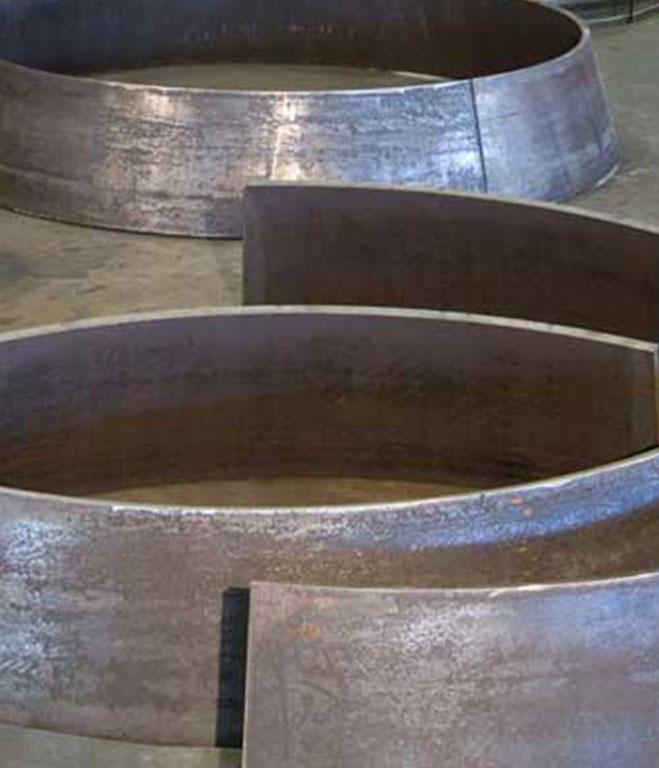
Rolling involves passing a plate through a set of rollers that gradually curve the material into a cylindrical or conical shape. Steel plate rolling in Houston is the standard method for creating shells for pressure vessels, tanks, pipes, and similar round or curved components.
Bending typically refers to forming a specific angle or curve in a plate using press brakes or other forming tools. Plate bending services in Houston cover everything from simple 90-degree bends to complex multi-radius forms.
Both processes require understanding the material's thickness, grade, yield strength, and springback behavior. Getting this right is what separates accurate parts from scrap.
Plate Rolling Techniques
Three-Roll Bending
This is the most common method for cylindrical plate rolling in Houston. The plate passes through three rolls arranged in a pyramid or pinch configuration. The rolls apply pressure to curve the plate gradually into a cylinder or arc.
Three-roll machines can produce full cylinders, partial arcs, and conical shapes depending on how the rolls are set up. They're used for pressure vessel shells, storage tank walls, pipe sections, and structural curved members.
Four-Roll Bending
Four-roll machines add a fourth roll that pinches and drives the plate more precisely. This reduces the flat end that forms at the entry and exit of the plate, which is a known limitation of three-roll systems.
Four-roll bending produces more consistent results with less pre-bending required. It's preferred for applications where end-to-end consistency matters.
Conical Rolling
Conical rolling uses angled roll settings to produce tapered sections. This is used for reducer sections, transition cones, and hopper bodies. It requires more setup and operator skill than cylindrical rolling.
Plate Bending Methods
Press Brake Bending
A press brake uses a punch and die to form bends in plate at specific angles. For heavy plate forming techniques, press brakes with high tonnage are required. Bending thick plate at tight radii demands machines with sufficient force to avoid cracking or underbending.
Air Bending
In air bending, the punch does not press the plate all the way to the die. The plate contacts only the edges of the die and the punch tip. The bend angle is controlled by how far the punch travels. Air bending requires less force and allows one die set to produce various angles.
Bottom Bending
Bottom bending, also called coining, presses the plate fully against the die. This produces more accurate and consistent angles but requires more force and specific tooling for each angle.
Roll Bending with Press Brake
For large-radius curves that fall between what a press brake and a plate roller each handles best, a combination approach is sometimes used. Pre-bending at the press brake is followed by rolling to complete the curve.
Industrial Metal Bending Services and Their Applications
The range of applications for plate rolling and bending in Houston is broad.
Pressure Vessels
Pressure vessel shells are almost always formed by rolling plate into cylinders, then welding the seam. The tolerance requirements are strict. The formed shell must meet roundness and straightness requirements before welding begins. Pressure vessel plate rolling is one of the most technically demanding applications in fabrication.
Storage Tanks
Above-ground and below-ground storage tanks use rolled plate for their shell courses. Each course is a cylinder formed from a flat plate. Multiple courses are stacked and welded to form the full tank height.
Ductwork and Industrial Housings
Curved duct sections, transition pieces, and equipment housings use both rolling and bending. The tolerances are generally less critical than pressure equipment, but fit-up accuracy matters for assembly.
Structural and Architectural Curved Members
Structural beams and plates are sometimes rolled into curved shapes for architectural frames, bridges, and specialty structures. This requires industrial metal bending services with the equipment to handle large, heavy sections.
Offshore and Marine Components
Industrial metal bending services serving the offshore sector work with thicker plate grades and require tighter tolerances on curvature and edge preparation.
What to Look for in a Plate Rolling and Bending Service
When you're evaluating plate rolling and bending in Houston, here are the key factors to consider:
Equipment capacity – Does the shop have rolls and press brakes with the tonnage and working width to handle your plate size and thickness?
Material capability – Can they roll and bend your specific material grade, including high-strength steels, stainless, and alloys?
Tolerances – What dimensional tolerances can they hold, and how do they verify compliance?
Secondary operations – Can they perform edge preparation, fit-up, or weld prep after forming to reduce your vendor count?
Experience with your application – A shop that has rolled pressure vessel shells has a different level of expertise than one that mainly bends light structural plate.
Final Thoughts
Plate rolling and bending in Houston is a specialized capability of metal workshops. Whether you're building pressure vessels, storage tanks, or structural components, the forming accuracy of your plate directly affects your downstream assembly, welding, and inspection steps.
Frequently Asked Questions
What is the minimum bend radius for thick steel plate?
Minimum bend radius depends on the plate's thickness, grade, and yield strength. As a general rule, the minimum radius is expressed as a multiple of the plate thickness, often 1 to 2 times the thickness for mild steel. High-strength steels require larger minimum radii to avoid cracking. Always consult material specifications and fabricator recommendations for your specific grade.
Can stainless steel plate be rolled and bent using the same equipment as carbon steel?
Yes, but with adjustments. Stainless steel work-hardens more than carbon steel, so it requires greater force for the same thickness and radius. Tooling must also be kept separate to avoid carbon steel contamination, which can cause corrosion in stainless. A qualified shop will have procedures in place to handle stainless separately.
How do I verify that a rolled shell meets roundness requirements?
Roundness is typically verified by measuring the inside diameter at multiple points around the circumference and comparing to the specified tolerance. Some applications reference ASME or other standards that define acceptable out-of-roundness. Your vendor should provide dimensional inspection records as part of their quality documentation.